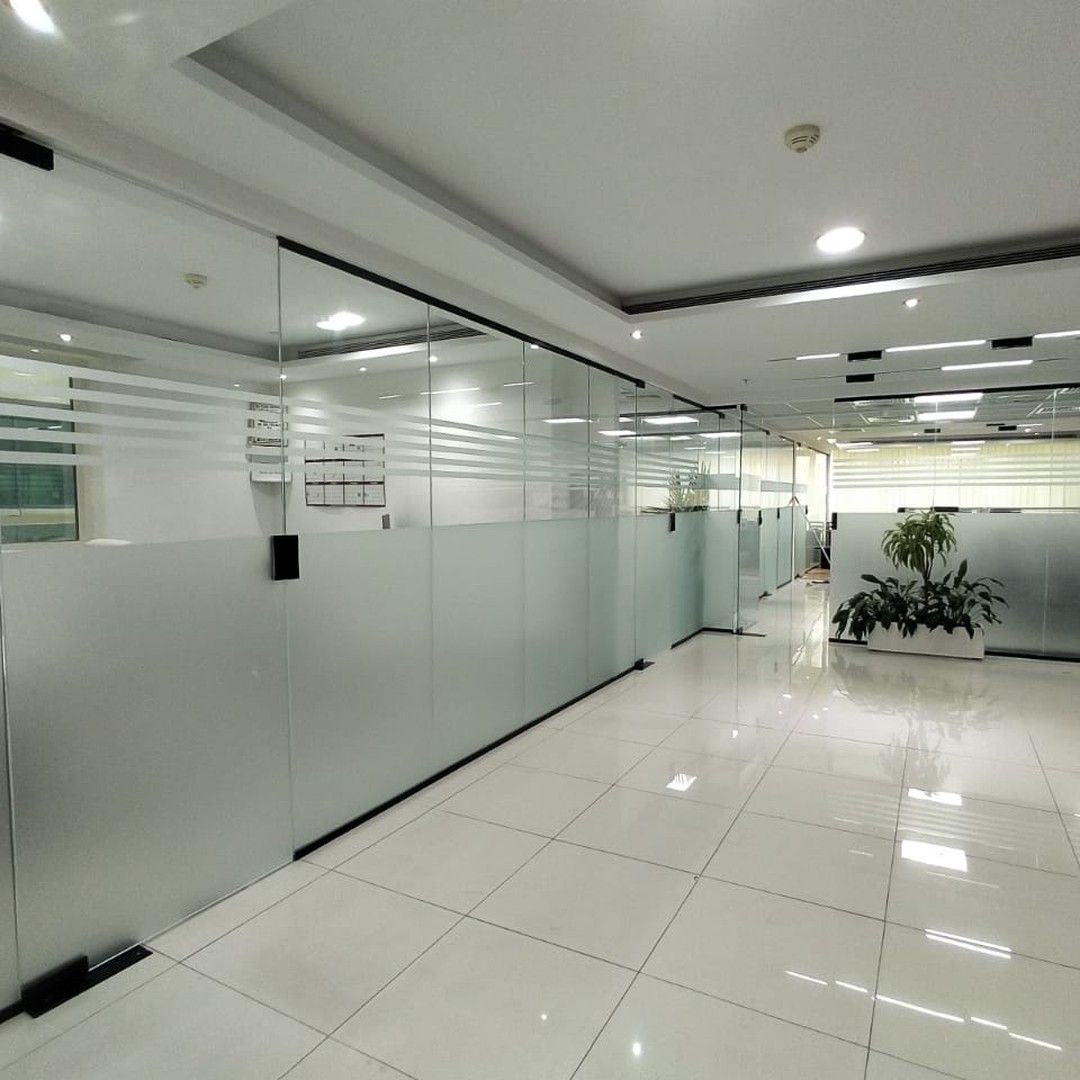
How much does office partitioning cost in Kenya? The answer depends on the type of partition, office size, materials, number of rooms, doors, finishes and installation requirements.
Office partitioning gives you a practical way to divide a large workspace without building permanent masonry walls. You can create private offices, meeting rooms, boardrooms, reception areas and staff spaces while making better use of the available floor area.
However, there is no single price for office partitioning in Kenya.
A basic gypsum partition costs much less than a premium frameless glass system. Likewise, a simple MDF partition costs less than an acoustic or fully glazed office system.
At InteriorDesigners.co.ke, we design and install office partitions based on the actual space, layout, business needs and budget.
Whether you need a small office partition, a complete corporate office layout or a full office fit-out, we can help you plan the project from measurement to installation.
Office Partitioning Cost in Kenya
The following table provides indicative budgeting ranges for common office partition systems in Kenya.
| Office Partition Type | Indicative Cost per m² |
|---|---|
| Standard gypsum partition | KSh 3,500 – 5,500 |
| Acoustic gypsum partition | KSh 5,000 – 7,000+ |
| MDF partition | KSh 4,500 – 8,500 |
| Aluminium + MDF/board | KSh 5,500 – 9,500 |
| Aluminium + clear glass | KSh 9,500 – 12,000 |
| Aluminium + frosted/tinted glass | KSh 10,500 – 13,000 |
| Slimline aluminium + glass | KSh 11,500 – 14,000 |
| Frameless toughened glass | KSh 13,500 – 18,000+ |
| Fully glazed aluminium system | KSh 14,000 – 20,000+ |
| Double-glazed/acoustic system | KSh 18,000 – 30,000+ |
These figures are indicative budgeting ranges. The actual quotation depends on the project specification.
Recent Kenya pricing references show similar variation. For example, published office partition quotations place standard gypsum around KSh 3,500–4,200/m², aluminium plus glass around KSh 9,500/m² and premium frameless glass from about KSh 13,500/m².
Therefore, the most accurate approach is to measure the office and prepare an itemised quotation.
What We Offer
At InteriorDesigners.co.ke, we provide complete office partitioning and interior design solutions.
Our services include:
- Office Partitioning Design
- Glass office partitions
- Aluminium office partitions
- MDF office partitions
- Gypsum office partitions
- Frameless glass partitions
- Toughened glass partitions
- Frosted glass partitions
- Aluminium and glass partitions
- Office glass doors
- Sliding office partitions
- Meeting room partitions
- Boardroom partitions
- Executive office partitions
- Acoustic partitions
- Office space planning
- 3D Design & Layout Planning
- Office Interior Design
- Office Fit-Out Services
We can also coordinate your partitions with flooring, ceilings, lighting, painting, furniture and branding.
As a result, you can manage the entire office transformation through one coordinated design and fit-out process.
What Is Office Partitioning?
Office partitioning involves dividing an existing workspace into separate rooms or working zones.
Instead of constructing permanent brick walls, you can use systems such as:
- Gypsum
- MDF
- Aluminium
- Glass
- Aluminium and glass
- Acoustic panels
- Demountable systems
The right system depends on how you want to use the space.
For example, a boardroom may benefit from glass, while a private HR office may require a solid or acoustic partition.
How Is Office Partitioning Cost Calculated?
Most contractors calculate office partitioning using the square metre of partition face area.
The basic formula is:
Partition area = Length × Height
For example, assume a partition measures:
10 metres long × 2.7 metres high
The area is:
10 × 2.7 = 27m²
If your selected partition costs KSh 9,500 per m²:
27 × KSh 9,500 = KSh 256,500
This gives you a basic partition estimate.
However, your final quotation can also include:
- Doors
- Handles
- Locks
- Frames
- Hardware
- Frosting
- Painting
- Electrical work
- Transport
- Installation
- Special finishes
Therefore, the square-metre rate should be treated as a starting point rather than the complete project price.
Example Office Partitioning Budget
Suppose a company wants to create several offices within a space.
The total partition face area is:
50m²
The company chooses an aluminium and clear glass system at approximately:
KSh 10,000/m²
The basic partition cost becomes:
50 × 10,000 = KSh 500,000
The project may then require four glass doors, additional hardware and other finishing work.
The final quotation will therefore depend on the complete specification.
This is why an itemised quotation provides a clearer picture of the actual office partitioning cost.
Types of Office Partitioning in Kenya
1. Gypsum Office Partitions
Gypsum partitions use a metal frame with gypsum boards.
They create a solid wall appearance and provide visual privacy.
Gypsum works well for:
- Private offices
- HR rooms
- Finance offices
- Storage rooms
- Staff rooms
- Server rooms
- Meeting rooms
You can also add insulation inside the wall to improve acoustic performance.
Benefits of Gypsum
Gypsum partitions offer:
- Privacy
- A solid appearance
- Flexible layouts
- Paintable surfaces
- Space for electrical wiring
- Good design flexibility
- Options for acoustic improvement
They are also among the more affordable office partition systems.
2. MDF Office Partitions
MDF partitions offer another practical option.
You can use laminated or painted MDF depending on the desired finish.
Common finishes include:
- White
- Grey
- Black
- Wood grain
- High gloss
- Custom colours
MDF partitions can work well in:
- Small offices
- Schools
- Clinics
- Salons
- Retail spaces
- Co-working spaces
They provide privacy while offering more decorative options than a basic wall.
3. Aluminium Office Partitions
Aluminium partitions use aluminium profiles as the main frame.
The infill can include:
- MDF
- Gypsum
- Glass
- Other board materials
Aluminium systems can also be demounted and reconfigured more easily than permanent masonry walls.
This makes them useful for businesses that expect their office layout to change.
4. Aluminium and Glass Office Partitions
Aluminium and glass partitions combine a strong frame with glass panels.
They are widely used in modern offices because they divide rooms without completely blocking light.
They can suit:
- Executive offices
- Boardrooms
- Meeting rooms
- Reception areas
- Manager’s offices
- Consultation rooms
You can use clear, frosted or tinted glass.
Recent Kenya pricing references place aluminium and glass systems broadly around KSh 9,500–16,000/m² depending on the frame, glass and finish.
5. Frameless Glass Office Partitions
Frameless glass provides a minimalist appearance.
The glass becomes the main visual element because there are fewer visible frames.
This style can work particularly well in:
- Boardrooms
- Executive offices
- Premium reception areas
- Meeting rooms
- Corporate offices
- Showrooms
Clear glass creates maximum visual openness.
Frosted glass can provide more privacy.
6. Toughened Glass Partitions
Toughened glass is widely used for modern office partitions.
Common specifications include:
- 8mm
- 10mm
- 12mm
The appropriate thickness depends on the system, panel size, support arrangement and intended use.
For more information, see our guide to tough glass partition installation.
7. Frosted Glass Partitions
Frosted glass reduces visibility while still allowing light to pass through.
It can work well for:
- HR offices
- Consultation rooms
- Finance offices
- Private meeting rooms
- Clinics
- Executive offices
You can frost the whole panel or use selected bands and patterns.
You can also add a company logo to create branded glass partitions.
8. Acoustic Office Partitions
Some businesses need more privacy and sound control.
For example, acoustic partitions can suit:
- Call centres
- Law offices
- Medical offices
- HR departments
- Boardrooms
- Consultation rooms
An acoustic system may use insulation, specialised boards, acoustic glass, seals or double-glazed construction.
The higher the required sound-control performance, the more the system can cost.
9. Demountable Office Partitions
Demountable systems allow businesses to change the office layout with less disruption.
They can be useful for:
- Co-working spaces
- Growing companies
- Flexible offices
- Training rooms
- Businesses in rented premises
The exact level of flexibility depends on the selected system.
Office Partitioning Cost by Material
Gypsum
Approximate range: KSh 3,500–7,000/m²
Gypsum can work well when privacy and cost control matter.
MDF
Approximate range: KSh 4,500–8,500/m²
MDF offers privacy with a range of decorative finishes.
Aluminium + MDF
Approximate range: KSh 5,500–9,500/m²
This system combines a clean frame with solid infill.
Aluminium + Glass
Approximate range: KSh 9,500–16,000/m²
This option creates a modern office with better light flow.
Frameless Glass
Approximate range: KSh 13,500–20,000+/m²
This system provides a premium, minimalist appearance.
Acoustic Systems
Approximate range: KSh 10,000–30,000+/m²
The final cost depends heavily on the required acoustic performance and system.
These ranges are useful for initial budgeting. A project-specific quotation remains necessary before construction.
What Affects Office Partitioning Cost in Kenya?
The material is only one part of the budget.
Several other factors affect the final cost.
1. Office Size
A larger office requires more partition material.
Therefore, the total square metres directly affect the budget.
2. Ceiling Height
A higher partition requires more material.
It may also need additional support.
3. Number of Rooms
A layout with many small rooms requires more partition lines and doors.
A simpler layout may need less material.
4. Number of Doors
Doors add to the cost.
You may need:
- Hinges
- Handles
- Locks
- Door frames
- Door closers
- Floor springs
- Sliding tracks
5. Glass Specification
Clear, frosted, tinted and decorative glass have different prices.
6. Partition Finish
Paint, laminate, wood-effect finishes and other decorative treatments affect the final price.
7. Hardware Quality
Good hardware can improve the operation and lifespan of the partition system.
8. Acoustic Requirements
Extra insulation and specialised systems increase the budget.
9. Electrical and Data Work
New rooms may require additional:
- Lighting
- Sockets
- Switches
- Data points
- Network connections
These services should be planned before installation.
10. Site Access
A project on a high floor or in a building with restricted access can require additional labour and logistics.
11. Project Location
Transport costs can vary between Nairobi and projects in other parts of Kenya.
12. Custom Designs
Curved glass, special colours, branding and unusual layouts can increase the cost.
Office Partitioning for Small Offices
Small offices require careful space planning.
You should avoid creating too many enclosed rooms if the available space is limited.
Instead, consider:
- Glass partitions
- Slimline aluminium systems
- Partial partitions
- Sliding doors
- Shared meeting rooms
- Compact private offices
Glass can help keep the space visually open.
At the same time, good furniture placement can improve circulation.
Office Partitioning for Large Offices
Large offices provide more design flexibility.
You can create:
- Reception
- Waiting areas
- Executive offices
- Meeting rooms
- Boardrooms
- Staff offices
- Training rooms
- Breakout spaces
- Open workstations
A combination of materials can work particularly well.
For example:
Glass + gypsum + aluminium + MDF
Each material can serve a different purpose.
Glass vs Gypsum Office Partitions
Both systems have useful applications.
| Feature | Glass | Gypsum |
|---|---|---|
| Natural light | Excellent | Limited |
| Visual openness | High | Low |
| Privacy | Low with clear glass; higher with frosting | High |
| Modern appearance | High | Flexible |
| Acoustic options | Available with specialised systems | Good with insulation |
| Design flexibility | High | High |
| Best use | Boardrooms, meeting rooms, executive offices | Private offices, stores, back offices |
The right choice depends on how the room will be used.
You can also combine both systems within one office.
Aluminium vs MDF Office Partitions
Aluminium and MDF can serve different needs.
| Feature | Aluminium System | MDF System |
|---|---|---|
| Appearance | Modern | Decorative |
| Natural light | Possible with glass | Limited |
| Privacy | Depends on infill | High |
| Reconfiguration | Often easier | Depends on construction |
| Finish options | Powder coating + infill | Laminate, paint, wood effect |
| Best use | Modern offices | Private and budget offices |
A mixed system can provide a practical balance.
Office Partition Doors
Doors form an important part of office partitioning.
Common options include:
Glass Doors
Suitable for:
- Boardrooms
- Meeting rooms
- Executive offices
MDF Doors
Suitable for:
- Private offices
- Storage rooms
- Staff areas
Aluminium-Framed Doors
These can work well with aluminium partition systems.
Sliding Doors
Sliding systems can save floor space.
The number and type of doors can have a noticeable effect on the final project cost.
Office Partition Design and Branding
Your office can use partitions as part of the company’s visual identity.
For example, you can use:
- Branded glass
- Frosted logos
- Company colours
- Feature walls
- Decorative films
- Custom aluminium finishes
This approach helps the office feel more connected to the brand.
It also creates a stronger visitor experience at reception and meeting areas.
Office Partitioning and Space Planning
Before installing partitions, think about how people will move through the office.
Consider:
- Reception
- Staff circulation
- Meeting rooms
- Private offices
- Toilets
- Kitchen or tea point
- Storage
- Emergency routes
- Natural light
- Furniture
- Electrical points
Good space planning helps prevent costly changes later.
At InteriorDesigners.co.ke, we can develop a layout before installation and coordinate the partition design with the wider office interior.
3D Office Partition Design
A 3D concept can help you understand the proposed office before installation.
You can review:
- Partition positions
- Room sizes
- Glass finishes
- Colours
- Doors
- Furniture placement
- Ceiling design
- Lighting
Explore our 3D Design & Layout Planning service before starting your office renovation or fit-out.
Office Partition Installation Process
Our office partitioning process can follow these stages:
1. Consultation
We discuss your office, business needs and budget.
2. Site Measurement
We measure the space and check existing conditions.
3. Space Planning
We determine the best room arrangement.
4. Design
We develop the partition layout and material specification.
5. Material Selection
We select glass, gypsum, MDF, aluminium, hardware and finishes.
6. Quotation
We prepare an itemised quotation based on the agreed specification.
7. Fabrication
The required components are prepared.
8. Installation
Our team installs the partition system.
9. Finishing
We complete painting, trims, fittings and related works.
10. Inspection and Handover
We check the completed installation and hand over the finished space.
How to Reduce Office Partitioning Costs
You can control costs without sacrificing the function of your office.
Plan the Layout First
A good layout reduces changes during construction.
Use Different Materials Strategically
You do not need premium glass everywhere.
Use glass where natural light and visibility matter.
Then use gypsum or MDF where you need privacy.
Limit Unnecessary Doors
Every additional door adds materials and hardware.
Choose Standard Finishes
Standard glass and laminate finishes can help control the budget.
Plan Electrical Work Early
Install electrical and data services before closing the partition.
Request an Itemised Quotation
An itemised quotation makes it easier to compare materials and understand the project budget.
Complete Office Fit-Out
Office partitioning often forms part of a larger renovation.
You may also need:
- Office interior design
- Reception design
- Flooring
- Gypsum ceilings
- Painting
- Lighting
- Electrical work
- Office furniture
- Branding
- Storage
- Kitchen or tea-point design
InteriorDesigners.co.ke can coordinate these services as part of a complete office fit-out.
Explore our Office Fit-Out Services for a complete solution.
What We Offer at InteriorDesigners.co.ke
Our office partitioning services include:
- Office space planning
- Partition design
- 3D office layouts
- Gypsum partitioning
- MDF partitioning
- Aluminium partitioning
- Glass partitioning
- Frameless glass partitions
- Toughened glass partitions
- Frosted glass partitions
- Aluminium and glass partitions
- Acoustic partition systems
- Office doors
- Boardroom partitions
- Meeting room partitions
- Executive office partitions
- Complete office fit-outs
We can also integrate partitions with:
- Commercial Interior Design
- Office Interior Design
- Gypsum Ceiling Installation
- Floor Installation
- Professional Painting
Why Choose InteriorDesigners.co.ke?
Office partitioning affects how people work every day.
Therefore, the design should focus on more than appearance.
At InteriorDesigners.co.ke, we consider:
- Space
- Privacy
- Natural light
- Circulation
- Furniture
- Storage
- Lighting
- Materials
- Budget
- Future flexibility
Our process can move from:
Consultation → Site Measurement → Space Planning → 3D Design → Material Selection → Quotation → Installation → Handover
This gives you a coordinated approach from the first design idea to the finished office.
Areas We Serve
InteriorDesigners.co.ke provides office partitioning and interior design services across Kenya, including Nairobi, Mombasa, Kiambu, Kajiado, Machakos, Nakuru, Kisumu, Uasin Gishu, Kilifi, Kwale, Nyeri, Meru, Embu, Kirinyaga, Murang’a, Nyandarua, Laikipia, Narok, Kericho, Bomet, Kakamega, Bungoma, Busia, Siaya, Kisii, Nyamira, Migori, Homa Bay, Nandi, Vihiga, Trans Nzoia, Kitui, Makueni, Taita-Taveta, Tana River, Lamu, Garissa, Wajir, Mandera, Marsabit, Isiolo, Samburu, Turkana, West Pokot, Baringo, Elgeyo-Marakwet and Tharaka-Nithi.
In Nairobi, we serve Nairobi CBD, Westlands, Karen, Runda, Muthaiga, Gigiri, Kitisuru, Lavington, Kileleshwa, Kilimani, Parklands, Riverside, Spring Valley, Upper Hill, Lang’ata, South C, South B, Embakasi, Kasarani, Roysambu and Ruaraka.
We can also handle projects outside Nairobi based on the project scope and site requirements.
Get an Office Partitioning Quotation in Kenya
The office partitioning cost in Kenya depends on your chosen system, office size and project specification.
A basic gypsum partition may cost around KSh 3,500–5,500 per m², while aluminium and glass systems can start around KSh 9,500 per m². Premium frameless and acoustic systems can cost considerably more.
However, the price per square metre is only the starting point.
Your final quotation can also include doors, hardware, finishes, electrical work, transport and installation.
Whether you are setting up a small office, renovating a corporate floor or planning a complete office fit-out, InteriorDesigners.co.ke can help you develop the right partitioning solution.
Ready to partition your office?
Contact Us Today for an office partitioning consultation, site measurement and quotation.
InteriorDesigners.co.ke
Phone: 0717 044 443 / 0739 255 050
Email: info@interiordesigners.co.ke
Frequently Asked Questions
How much does office partitioning cost in Kenya?
Office partitioning can start from around KSh 3,500 per m² for basic gypsum systems. MDF can start around KSh 4,500 per m², while aluminium and glass systems can start around KSh 9,500 per m². Premium frameless and acoustic systems cost more.
What is the cheapest office partitioning option?
Basic gypsum partitions are generally among the lower-cost options. MDF can also provide a practical solution where you need a finished surface and privacy.
How much does MDF partitioning cost in Kenya?
MDF partitioning can range from approximately KSh 4,500–8,500+ per m², depending on the board, frame, laminate, paint and overall specification.
How much does aluminium partitioning cost in Kenya?
Aluminium partitioning varies according to the infill. Aluminium with MDF or board can cost around KSh 5,500–9,500/m², while aluminium and glass systems can start around KSh 9,500/m² and increase with the glass and frame specification.
How much does glass office partitioning cost?
Glass office partitioning can range from approximately KSh 9,500–20,000+ per m², depending on the frame, glass type, thickness, doors and finish.
Is office partitioning charged per square metre?
Yes. Most partitioning projects use the face area of the partition. Contractors calculate this by multiplying the partition length by its height.
Does the price include installation?
It depends on the quotation. Some published rates include supply and installation, while other market listings may cover materials only. Always confirm what your quotation includes.
Can I combine glass and gypsum partitions?
Yes. Combining materials can provide a useful balance between natural light, privacy and cost.
Which partition is suitable for a boardroom?
Glass, particularly aluminium-framed or frameless toughened glass, can work well for boardrooms where businesses want visibility and natural light. Acoustic specifications can be added when sound control matters.
Which partition is suitable for private offices?
Gypsum, MDF or acoustic systems can work well where visual privacy matters. Frosted glass can also provide privacy while maintaining natural light.
Can office partitions be removed later?
Some aluminium and demountable systems can be dismantled and reconfigured. The ability to reuse the materials depends on the specific system and installation method.
Can you partition an existing office?
Yes. We can assess the existing space, take measurements and develop a partition layout around the current building structure and services.
Do you provide complete office interior design?
Yes. Office partitioning can form part of a complete office interior design and fit-out project.