Best Kitchen Countertop Materials in Kenya: Prices, Pros and Cons
Choosing the right countertop is an important part of planning a functional and attractive kitchen. It is one of the most frequently used surfaces in the home, so it needs to withstand daily cooking, cleaning, heat and general use.
The best kitchen countertop materials in Kenya include granite, quartz, marble, porcelain, laminate and sintered stone. Each material has different qualities, maintenance requirements and prices.
Some homeowners prefer natural stone because of its unique patterns and durability. Others choose engineered surfaces because they offer consistent colours and easier maintenance. However, the best option depends on your budget, cooking habits, kitchen design and preferred finish.
At Suimas Interiors, we help homeowners select suitable countertop materials as part of their kitchen interior design and installation projects.
This guide compares popular kitchen countertop materials in Kenya, their estimated prices, advantages, disadvantages and the best applications for each.
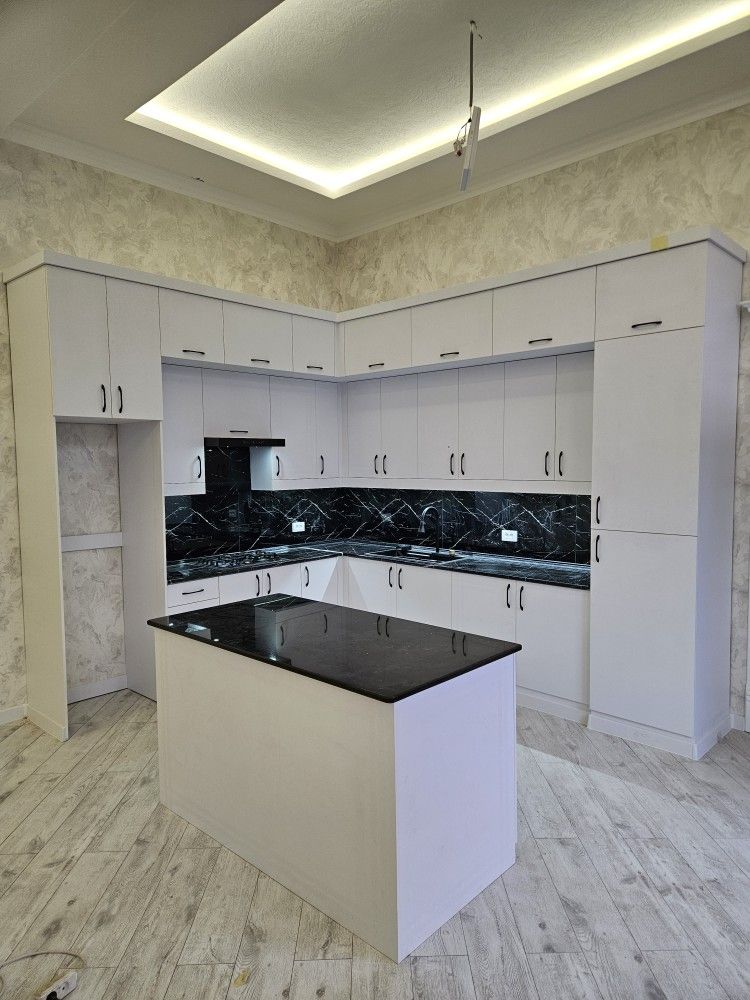
What Are the Best Kitchen Countertop Materials in Kenya?
There is no single countertop material that suits every kitchen. However, the following options are among the main materials to consider.
- Granite – a durable natural stone with unique patterns.
- Quartz – an engineered surface with consistent colours and low maintenance.
- Marble – a premium natural stone with distinctive veining.
- Porcelain and ceramic tiles – practical options for budget-conscious projects.
- Laminate – an affordable option available in different colours and designs.
- Sintered stone – a premium surface with excellent resistance to heat, scratches and stains.
- Solid surface – a versatile material that can create a smooth, seamless appearance.
1. Granite Countertops
Granite is one of the most popular kitchen countertop materials in Kenya. It is a natural stone formed from cooled molten rock and is available in different colours, patterns and finishes.
Each granite slab has its own natural appearance. This makes it suitable for homeowners who prefer a unique countertop rather than a uniform manufactured design.
<image-placeholder>Granite kitchen countertop with natural stone patterns and modern cabinets</image-placeholder>
Advantages of Granite
- Durable and suitable for everyday kitchen use.
- Good resistance to heat.
- Scratch resistant under normal kitchen use.
- Available in different natural colours and patterns.
- Adds a premium appearance to kitchen cabinets.
- Suitable for both modern and traditional kitchens.
Disadvantages of Granite
- Requires periodic sealing depending on the stone and sealer used.
- Some varieties can absorb liquids if not properly sealed.
- Natural patterns may vary between slabs.
- Heavy slabs require suitable cabinet support.
- Certain imported varieties can be expensive.
Estimated Granite Countertop Price in Kenya
| Granite type | Indicative price per m² |
|---|---|
| Local granite | KES 8,000–18,000 |
| Imported granite | KES 18,000–30,000 |
Prices depend on the granite variety, thickness, finish, fabrication and installation requirements.
Best for: Homeowners looking for a durable natural stone countertop at a reasonable price.
2. Quartz Countertops
Quartz is an engineered stone made using natural quartz particles combined with resins, pigments and other materials.
It is popular in modern kitchens because it offers consistent colours, attractive patterns and relatively easy maintenance.
<image-placeholder>White quartz countertop with contemporary kitchen cabinets and a kitchen island</image-placeholder>
Quartz is available in different finishes, including plain white, grey, black, marble-effect and textured designs.
Advantages of Quartz
- Non-porous surface that does not normally require sealing.
- Good resistance to everyday stains.
- Available in consistent colours and patterns.
- Easy to clean using suitable household cleaning products.
- Suitable for modern kitchens and kitchen islands.
- Available in different colours and finishes.
Disadvantages of Quartz
- Generally more expensive than local granite.
- Can be damaged by excessive heat.
- Some products may discolour when exposed to prolonged direct sunlight.
- Poor-quality products may have inconsistent finishes.
- Heavy impact can damage edges and corners.
Estimated Quartz Countertop Price in Kenya
| Quartz type | Indicative price per m² |
|---|---|
| Standard quartz | KES 18,000–24,000 |
| Premium quartz | KES 24,000–35,000 |
The final price depends on the brand, colour, slab thickness, edge profile, cut-outs and installation.
Best for: Modern family kitchens, homeowners who prefer low-maintenance surfaces and contemporary kitchen islands.
3. Marble Countertops
Marble is a natural stone known for its elegant appearance and distinctive veins. It is commonly used in luxury kitchens and interior design projects.
White marble with grey or gold veining is particularly popular for statement kitchen islands and feature surfaces.
<image-placeholder>Luxury kitchen with white marble countertop and natural stone veining</image-placeholder>
Advantages of Marble
- Elegant and luxurious appearance.
- Natural patterns make each slab distinctive.
- Available in different colours and vein patterns.
- Suitable for feature islands and decorative surfaces.
- Provides a classic finish for premium kitchen designs.
Disadvantages of Marble
- More susceptible to scratches than granite.
- Can react with acidic substances such as lemon juice and vinegar.
- May stain if spills are not cleaned promptly.
- Requires careful maintenance and appropriate sealing.
- Premium imported varieties can be expensive.
Estimated Marble Countertop Price in Kenya
| Marble type | Indicative price per m² |
|---|---|
| Local marble | KES 20,000–40,000 |
| Imported marble | KES 45,000–90,000+ |
Prices vary depending on the stone origin, quality, colour, thickness and fabrication requirements.
Best for: Luxury kitchen islands, decorative surfaces and homeowners who prioritise natural stone aesthetics and are comfortable with regular maintenance.
4. Porcelain and Ceramic Tile Countertops
Porcelain and ceramic tiles offer another option for kitchen countertops. They are installed over a suitable prepared base and are available in different colours, patterns and sizes.
Large-format porcelain tiles can create a modern appearance, while smaller ceramic tiles offer more traditional design possibilities.
<image-placeholder>Kitchen countertop finished with large-format porcelain tiles</image-placeholder>
Advantages of Porcelain and Ceramic Tiles
- Available in different colours and patterns.
- Some varieties provide good resistance to heat.
- Porcelain tiles generally have low water absorption.
- Can be more affordable than premium stone surfaces.
- Individual damaged tiles may be replaced.
- Suitable for different kitchen styles.
Disadvantages of Porcelain and Ceramic Tiles
- Grout lines require regular cleaning.
- Poor installation can result in uneven surfaces.
- Tile edges may chip under impact.
- Small tiles create more grout joints.
- The finished appearance may not be as seamless as stone slabs.
Estimated Porcelain and Ceramic Countertop Price in Kenya
| Material | Indicative price per m² |
|---|---|
| Ceramic or porcelain tile | KES 3,000–8,000 |
The actual cost depends on the tile quality, size, countertop base, edge treatment, grout and installation.
Best for: Budget-conscious kitchens, rental properties and projects where tiled surfaces suit the overall design.
5. Laminate Countertops
Laminate countertops are made using decorative laminate sheets bonded to a suitable board or countertop substrate.
They are available in many colours and patterns, including wood-effect, marble-effect, plain colours and textured finishes.
<image-placeholder>Modern kitchen with wood-effect laminate countertop</image-placeholder>
Advantages of Laminate
- More affordable than many natural and engineered stone surfaces.
- Available in a wide range of designs.
- Lightweight compared with stone slabs.
- Easy to clean with suitable products.
- Can suit simple and contemporary kitchen designs.
- Available in different finishes.
Disadvantages of Laminate
- Can be damaged by direct heat.
- Scratches and cuts may damage the decorative surface.
- Water can cause swelling if it enters exposed joints or edges.
- Damaged laminate is not always easy to repair invisibly.
- Generally less durable than granite and other stone surfaces.
Estimated Laminate Countertop Price in Kenya
Indicative prices for post-formed laminate countertops are approximately KES 2,500–5,000 per running foot.
The final cost depends on the board specification, laminate finish, countertop depth, edge profile, cut-outs and installation.
Best for: Affordable kitchen installations, rental properties and homeowners working with a limited budget.
6. Sintered Stone Countertops
Sintered stone is a manufactured surface produced by compacting and processing mineral materials under high pressure and heat.
It is commonly used in premium kitchens because it offers a refined appearance and strong resistance to heat, scratches and everyday stains.
<image-placeholder>Luxury kitchen island with large-format sintered stone countertop</image-placeholder>
Advantages of Sintered Stone
- High resistance to heat.
- Excellent scratch resistance under normal use.
- Low porosity.
- Good resistance to stains.
- Available in marble, concrete and natural stone-effect designs.
- Suitable for large kitchen islands and contemporary kitchens.
- Some products are suitable for outdoor applications.
Disadvantages of Sintered Stone
- Higher initial cost than many standard countertop materials.
- Can chip at edges if handled or installed incorrectly.
- Requires experienced fabricators and installers.
- Specialised cutting and installation equipment may be required.
- Some designs and colours may have longer supply lead times.
Estimated Sintered Stone Countertop Price in Kenya
The indicative price ranges from KES 28,000–55,000 per m².
Premium imported brands and specialised finishes may cost more.
Best for: Premium kitchens, large islands and homeowners seeking a modern surface with strong performance characteristics.
7. Solid Surface Countertops
Solid surface countertops are manufactured using materials such as acrylic resins and mineral fillers. They are available in different colours and can be fabricated into smooth, continuous-looking surfaces.
They are particularly useful where a homeowner wants an integrated appearance around sinks, worktops and selected kitchen features.
<image-placeholder>Modern kitchen with seamless solid surface countertop and integrated sink</image-placeholder>
Advantages of Solid Surface
- Smooth and non-porous surface.
- Available in different colours and patterns.
- Can be fabricated with discreet joints.
- Some minor scratches can be repaired by professional refinishing.
- Can be formed into curved and customised designs.
- Suitable for integrated sink designs.
Disadvantages of Solid Surface
- Can scratch more easily than granite and sintered stone.
- May be damaged by direct contact with very hot cookware.
- Quality and durability vary between products.
- Professional fabrication is important.
- Premium designs can be expensive.
Best for: Contemporary kitchens, customised designs and homeowners who prefer smooth surfaces with minimal visible joints.
Kitchen Countertop Materials Compared
The following table summarises the main differences between the materials.
| Material | Durability | Heat resistance | Maintenance | Best use |
|---|---|---|---|---|
| Granite | High | Excellent | Medium | Everyday family kitchens |
| Quartz | High | Moderate | Low | Modern kitchens |
| Marble | Moderate | Good | High | Feature surfaces |
| Porcelain/ceramic | Good | Good to excellent, depending on product | Low to medium | Budget and modern kitchens |
| Laminate | Moderate | Low | Low | Affordable kitchens |
| Sintered stone | High | Excellent | Low | Premium kitchens |
| Solid surface | Moderate | Low to moderate | Low to medium | Seamless customised designs |
Performance varies by product, thickness, fabrication and installation. Always check the manufacturer’s specifications before selecting a material.
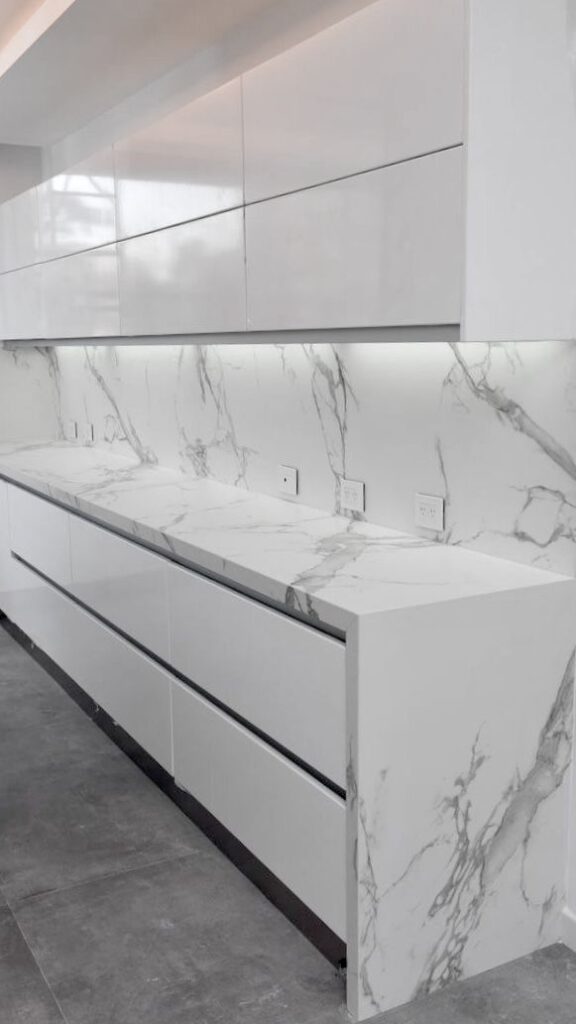
Kitchen Countertop Prices in Kenya
The following table provides a quick comparison of indicative countertop prices.
| Countertop material | Estimated price |
|---|---|
| Ceramic or porcelain tile | KES 3,000–8,000 per m² |
| Local granite | KES 8,000–18,000 per m² |
| Imported granite | KES 18,000–30,000 per m² |
| Quartz | KES 18,000–35,000 per m² |
| Sintered stone | KES 28,000–55,000 per m² |
| Local marble | KES 20,000–40,000 per m² |
| Imported marble | KES 45,000–90,000+ per m² |
| Laminate | KES 2,500–5,000 per running foot |
These are indicative planning figures, not guaranteed supplier prices. They may not include every fabrication or installation requirement. Always request a quotation based on the actual measurements and selected material.
How to Choose the Best Kitchen Countertop for Your Home
Before selecting a countertop, consider how you use your kitchen and what you expect from the surface.
1. Consider Your Budget
Your budget will determine which materials are practical for your project.
- For a budget kitchen, consider laminate or porcelain tiles.
- For a mid-range kitchen, compare local granite and standard quartz.
- For a premium kitchen, consider premium quartz or imported granite.
- For a luxury kitchen, explore sintered stone and selected marble options.
Remember to include fabrication, installation, transportation and cut-outs in your budget.
2. Consider Your Cooking Habits
If you cook frequently, choose a surface that can withstand regular use and is easy to maintain.
Granite and sintered stone offer good heat resistance. Quartz is convenient for everyday cleaning, but hot pots should be placed on trivets rather than directly on the surface.
3. Consider Maintenance Requirements
Some countertop materials require more attention than others.
Granite and marble may require periodic sealing. Quartz and many sintered stone surfaces generally do not require sealing. Laminate needs protection from excessive heat and moisture, especially around joints and edges.
4. Match the Countertop With Your Kitchen Cabinets
Your countertop should complement your cabinet colour, flooring, backsplash and lighting.
Some popular combinations include:
- White quartz with grey or wood-finish cabinets.
- Black granite with white kitchen cabinets.
- Marble-effect quartz with beige or cream cabinets.
- Grey granite with natural timber finishes.
- Light sintered stone with handleless kitchen cabinets.
- Wood-effect laminate with simple contemporary cabinetry.
5. Check the Thickness and Edge Profile
Countertops are available in different thicknesses and edge designs. A thicker-looking countertop can create a bold appearance, while a slim profile suits minimalist kitchens.
Ask the supplier about the actual slab thickness, any built-up edges, support requirements and the available edge profiles.
6. Consider Installation and Cabinet Support
Stone countertops can be heavy. The cabinets and supporting structure must be suitable for the selected material.
Accurate measurements are also important, especially around sinks, cookers, wall corners and kitchen islands.
Popular Kitchen Countertop Colours and Designs in Kenya
The colour and pattern of your countertop influence the overall appearance of the kitchen.
Some popular design choices include:
White countertops: Suitable for bright, clean-looking kitchens. They work well with white, grey, beige and timber cabinets.
Black countertops: Create contrast and can give a kitchen a bold appearance. Black granite and quartz are common choices.
Grey countertops: Provide a neutral finish that works with many cabinet colours.
Beige and cream countertops: Suitable for warm, natural-looking kitchen designs.
Marble-effect countertops: Provide the appearance of natural marble with different levels of maintenance depending on the material selected.
Concrete-effect countertops: Suit industrial, minimalist and contemporary kitchen interiors.
Common Kitchen Countertop Installation Mistakes to Avoid
Choosing a good material is only one part of getting a successful result. Proper measurement, preparation and installation are equally important.
Avoid these common mistakes:
- Choosing a material based on appearance alone without checking its specifications.
- Ignoring the weight of the countertop when designing the cabinets.
- Failing to confirm the exact position of the sink and cooker cut-outs.
- Selecting a surface without considering heat and moisture exposure.
- Using unsuitable cleaning products.
- Ignoring the quality of the edge finishing.
- Failing to check the slab for defects before fabrication.
- Choosing an installer without relevant experience.
- Failing to confirm whether transportation and installation are included in the quotation.
A professional site measurement and material assessment can help prevent unnecessary costs and installation problems.
Other Related Kitchen Interior Design Services We Offer
Suimas Interiors provides additional solutions to help create a coordinated kitchen design.
- Kitchen Cabinets, Wardrobes and Joinery
- Kitchen Interior Design
- Kitchen Remodeling
- Floor Installation Services
- Gypsum Ceilings and Integrated Lighting
- Painting and Special Effect Finishes
Kitchen Interior Design Services in Nairobi and Across Kenya
Suimas Interiors provides kitchen interior design, cabinetry, countertop selection and installation solutions in Nairobi and other parts of Kenya.
In Nairobi, we serve clients in the CBD, Westlands, Upper Hill, Kilimani, Lavington, Parklands, Karen, Runda, Gigiri, Riverside, Hurlingham, Eastleigh, Industrial Area, South B, South C and Mombasa Road.
We also serve clients across all 47 counties in Kenya: Mombasa, Kwale, Kilifi, Tana River, Lamu, Taita-Taveta, Garissa, Wajir, Mandera, Marsabit, Isiolo, Meru, Tharaka-Nithi, Embu, Kitui, Machakos, Makueni, Nyandarua, Nyeri, Kirinyaga, Murang’a, Kiambu, Turkana, West Pokot, Samburu, Trans Nzoia, Uasin Gishu, Elgeyo-Marakwet, Nandi, Baringo, Laikipia, Nakuru, Narok, Kajiado, Kericho, Bomet, Kakamega, Vihiga, Bungoma, Busia, Siaya, Kisumu, Homa Bay, Migori, Kisii, Nyamira and Nairobi.
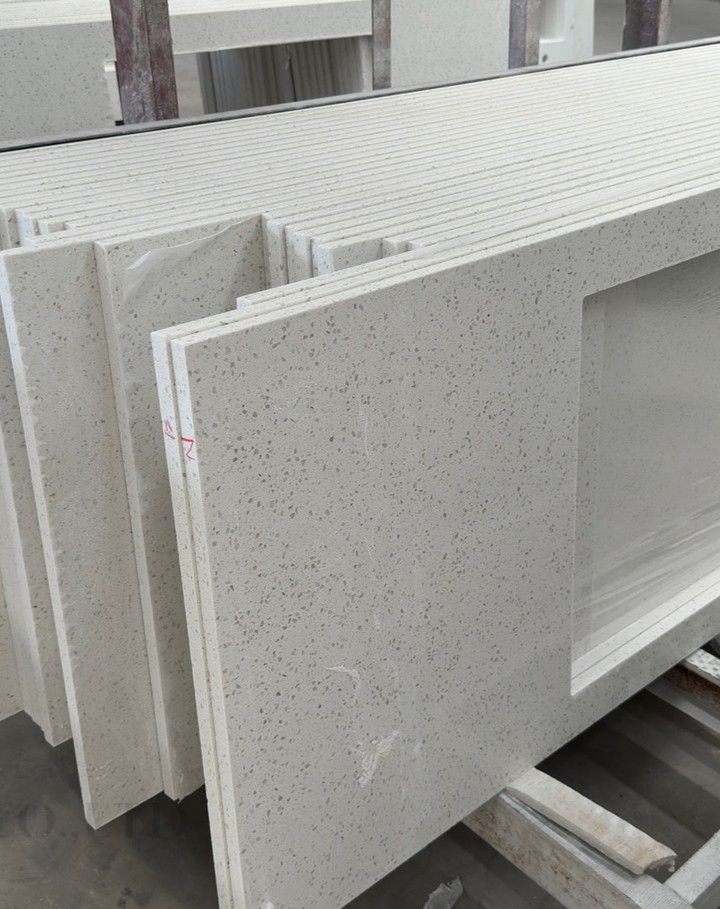
Get Kitchen Countertop and Interior Design Solutions from Suimas Interiors
Looking for the right countertop for your kitchen?
Suimas Interiors can help you select suitable materials, plan your kitchen layout and coordinate your cabinets, countertops and finishes.
Contact us to discuss your kitchen project and request a quotation.
Suimas Interiors
- Call or WhatsApp: 0717 044 443
- Office: Solar House, 4th Floor, Moi Avenue, Nairobi CBD
- Website: www.suimas.co.ke
Frequently Asked Questions About Kitchen Countertop Materials in Kenya
1. Which is the best kitchen countertop material in Kenya?
Quartz is a strong all-round option for homeowners who want a low-maintenance surface with consistent colours and good stain resistance. Granite is another excellent option, particularly for those who prefer natural stone and good heat resistance. The best choice depends on your budget, cooking habits and preferred design.
2. Is granite better than quartz for kitchen countertops?
Granite is a natural stone with excellent heat resistance and unique patterns. Quartz is engineered, generally non-porous and easier to maintain because it does not require sealing. However, quartz is less tolerant of direct heat. Both are good options when correctly selected and installed.
3. How much does a granite countertop cost in Kenya?
Indicative granite countertop prices range from KES 8,000–18,000 per square metre for local granite and KES 18,000–30,000 per square metre for imported granite. The final price depends on the variety, thickness, finish, fabrication and installation.
4. How much does a quartz countertop cost in Kenya?
Quartz countertops generally cost approximately KES 18,000–35,000 per square metre. Premium brands, colours, thicknesses and specialised fabrication may increase the price.
5. Is marble suitable for kitchen countertops?
Marble can create a beautiful kitchen finish, but it requires more care than granite and quartz. It is vulnerable to staining and etching from acidic substances. It is often better suited to decorative islands and feature surfaces than heavily used preparation areas.
6. Which countertop material is easiest to maintain?
Quartz and many sintered stone surfaces are relatively easy to maintain because they generally do not require sealing. Regular cleaning with suitable products is usually sufficient. Always follow the manufacturer’s care instructions.
7. Which countertop is best for a small kitchen?
Quartz, granite and laminate can all work well in small kitchens. Light colours can help create a brighter appearance, while carefully selected patterns can make the space feel more coordinated. The choice should also consider the cabinet layout and available budget.
8. Can I install a new countertop without replacing my kitchen cabinets?
Yes, it may be possible to replace the countertop while retaining existing cabinets. However, the cabinets must be in good condition, properly supported and suitable for the new countertop. Measurements and an assessment of the cabinet structure should be completed before installation.
9. How thick should a kitchen countertop be?
The suitable thickness depends on the material, design and manufacturer’s specifications. Common stone countertop options include slabs around 20 mm and 30 mm thick. The cabinet support, edge profile and installation method should be considered before selecting the thickness.
10. How do I choose the right countertop colour?
Choose a colour that complements your kitchen cabinets, flooring, backsplash and lighting. White, grey, black, beige and marble-effect finishes are popular options. It is advisable to view a physical sample or full slab because colours and patterns can appear different under different lighting conditions.
11. Does Suimas Interiors provide kitchen countertop installation in Kenya?
Suimas Interiors provides kitchen interior design and related cabinetry and finishing solutions. Contact the team to discuss your countertop requirements, material selection and installation arrangements.
