Quartz vs Granite Countertops in Kenya: Prices, Differences and Which Is Better?
Choosing the right kitchen countertop is an important part of creating a functional, attractive and durable kitchen. Among the most popular materials available today are quartz and granite countertops. Both offer excellent durability, attractive finishes and long-term value. However, they differ in appearance, maintenance requirements, heat resistance, stain resistance and installation costs.
In Kenya, quartz and granite countertops are increasingly popular in modern apartments, family homes, luxury villas and commercial kitchens. Granite is appreciated for its natural beauty, strength and excellent heat resistance. Quartz, on the other hand, offers consistent colours, contemporary patterns and easier maintenance.
But which material is better for your kitchen? Is quartz worth the higher investment, or is granite a more practical choice?
This comprehensive guide explores quartz vs granite countertops in Kenya, including their prices, advantages, disadvantages, designs, maintenance requirements and installation considerations. Whether you are building a new kitchen or renovating an existing one, understanding these differences will help you make an informed decision.

Why Choosing the Right Kitchen Countertop Matters
A kitchen countertop is more than a decorative surface. It plays an important role in the functionality, appearance and durability of your kitchen.
Since countertops are used for food preparation, appliance placement, storage and everyday activities, choosing the right material can significantly affect your kitchen experience.
Here are some important reasons to select your countertop carefully:
- Durability: A quality countertop should withstand everyday kitchen activities without developing unnecessary damage.
- Appearance: The countertop should complement your kitchen cabinets, flooring, backsplash and overall interior design.
- Maintenance: Different materials have different cleaning and maintenance requirements.
- Heat resistance: Consider how well the surface handles exposure to hot cookware.
- Stain resistance: A suitable countertop should resist common kitchen spills and stains.
- Long-term value: Investing in quality materials can reduce replacement and maintenance expenses over time.
Quartz and granite are both excellent choices. However, the best option depends on your kitchen design, lifestyle and available budget.
Estimated Quartz and Granite Countertop Prices in Kenya
One of the first considerations when choosing between quartz and granite is the installation cost.
In Kenya, countertop prices vary depending on the material, thickness, colour, quality, origin, fabrication and installation requirements.
The following are indicative budgeting estimates:
| Countertop Material | Estimated Price per m² |
|---|---|
| Local Kenyan granite | KES 8,000–18,000 |
| Imported granite | KES 18,000–30,000 |
| Standard quartz | KES 18,000–24,000 |
| Mid-range quartz | KES 24,000–30,000 |
| Premium quartz | KES 30,000–35,000 |
These are indicative estimates rather than verified supplier quotations. Special imported varieties and premium finishes may cost more.
Additional installation expenses may include transportation, measurements, cutting, edge finishing, sink cut-outs, cooker openings and installation labour.
Generally, locally sourced granite offers a more affordable starting point, while engineered quartz provides consistent finishes and relatively low maintenance.

1. What Is a Quartz Countertop?
Quartz countertops are engineered stone surfaces manufactured using natural quartz crystals combined with resin, pigments and other materials.
Unlike granite, which is extracted directly from natural stone deposits, quartz is manufactured under controlled conditions. This allows manufacturers to produce countertops with consistent colours, patterns and finishes.
Quartz is popular in contemporary kitchen designs because it offers a refined appearance and excellent resistance to everyday stains.
Popular Quartz Countertop Designs in Kenya
White Quartz Countertops
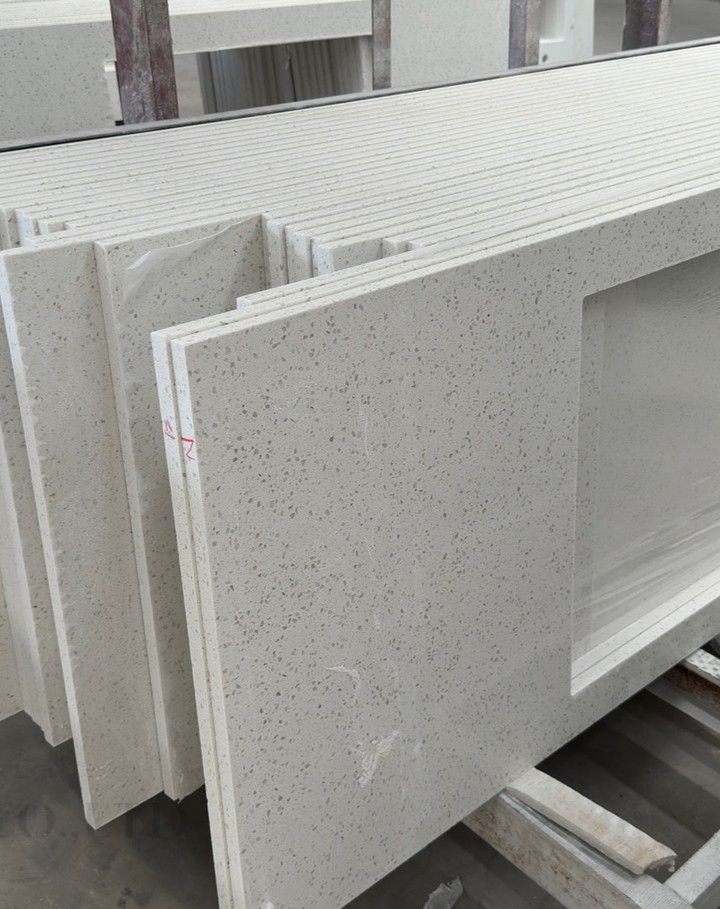
White quartz is a popular choice for modern kitchens. It creates a bright, clean appearance and complements white, grey, black and wooden kitchen cabinets.
Some varieties feature subtle grey veins that create a marble-like appearance.
Grey Quartz Countertops
Grey quartz provides a sophisticated and contemporary appearance. It works particularly well with white cabinetry, black accessories and neutral-coloured walls.
Black Quartz Countertops
Black quartz creates a bold and elegant kitchen appearance. It is suitable for luxury kitchens, modern kitchen islands and contemporary interior designs.
Calacatta-Style Quartz
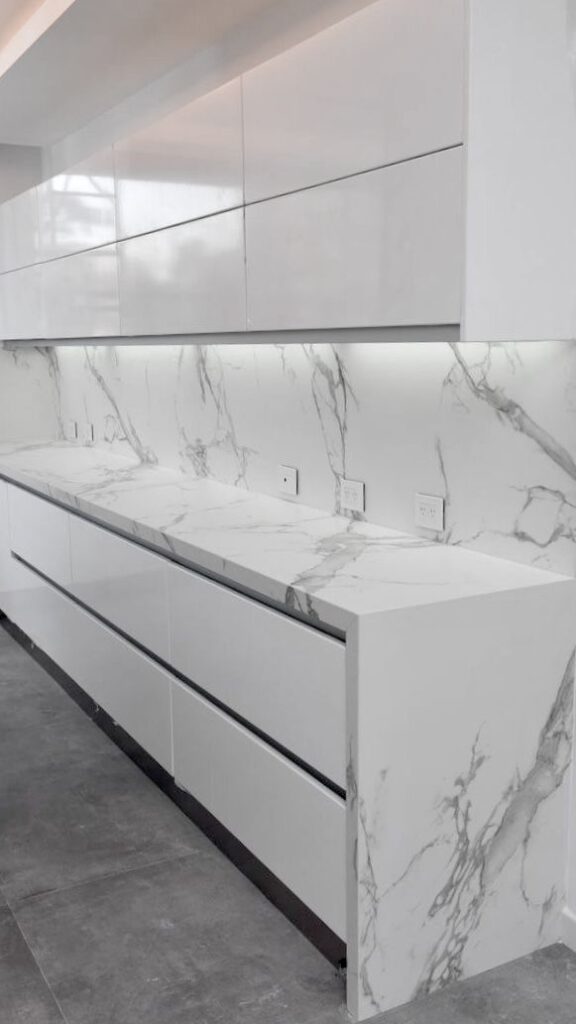
Calacatta-style quartz features a white background with prominent grey or gold veining. It is an attractive option for homeowners who appreciate marble-inspired designs but prefer the maintenance characteristics of engineered quartz.
Beige and Cream Quartz
Beige and cream quartz surfaces introduce warmth into kitchen interiors. They complement wooden cabinetry, natural flooring and neutral interior finishes.
Advantages of Quartz Countertops
Quartz offers several benefits that make it suitable for residential and commercial kitchen applications.
- Non-porous surface: Quality engineered quartz is generally non-porous, reducing liquid absorption.
- Easy maintenance: It does not require periodic sealing like natural granite.
- Consistent appearance: Manufactured patterns make it easier to achieve uniform finishes.
- Stain resistance: It offers good resistance to common kitchen stains.
- Modern designs: Available in numerous colours, patterns and finishes.
- Hygienic surface: Its non-porous construction makes everyday cleaning easier.
- Versatile applications: Suitable for countertops, kitchen islands, breakfast bars and selected bathroom surfaces.
Disadvantages of Quartz Countertops
Despite its advantages, quartz has some limitations.
- Higher initial cost: Premium quartz can cost more than locally sourced granite.
- Heat sensitivity: Excessive heat can damage or discolour the resin components.
- UV sensitivity: Some quartz products may discolour with prolonged direct sunlight.
- Professional installation: Accurate measurements and specialised fabrication are necessary.
- Repair challenges: Significant damage can be difficult to repair invisibly.
2. What Is a Granite Countertop?
Granite is a natural igneous stone formed through the cooling and solidification of molten material beneath the Earth’s surface.
It is extracted from quarries, processed into slabs and fabricated into countertops.
Granite is popular in Kenyan homes because of its natural beauty, strength and ability to withstand everyday kitchen activities.
Each granite slab has unique patterns, mineral variations and colours. This gives every kitchen a distinctive appearance.
Popular Granite Countertop Designs in Kenya
Black Granite Countertops
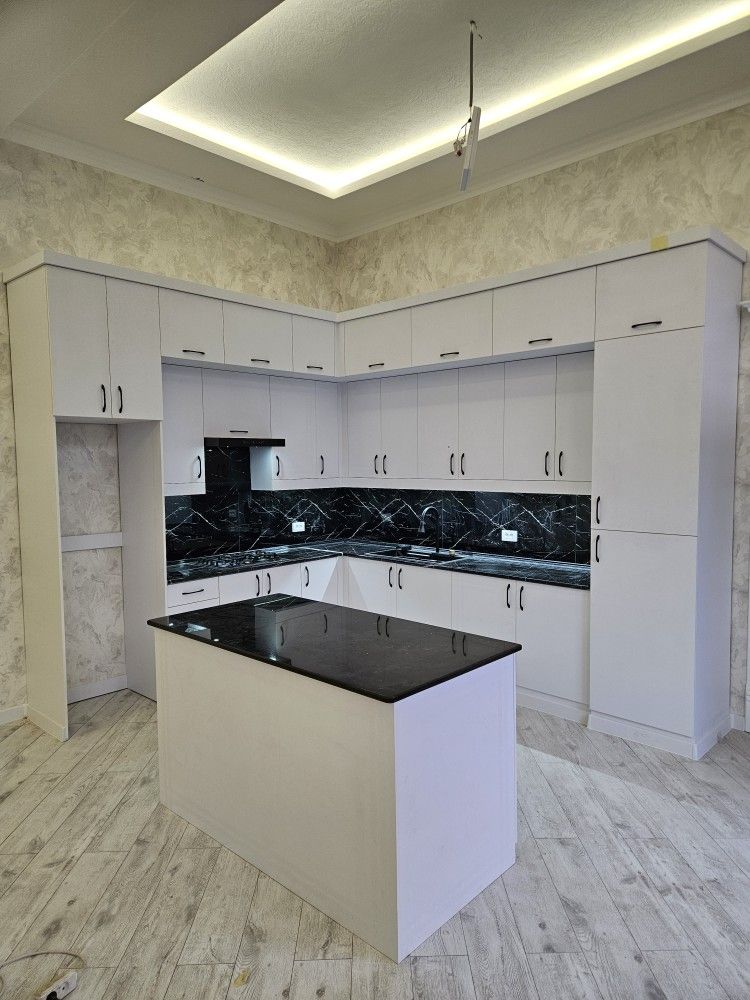
Black granite is suitable for contemporary and luxury kitchen designs. It pairs well with white cabinets, wooden finishes and metallic accessories.
White Granite Countertops
White granite creates a bright and spacious appearance. Its natural mineral patterns add character without overwhelming the kitchen design.
Grey Granite Countertops
Grey granite offers a neutral appearance that complements different cabinet colours, flooring materials and kitchen layouts.
Brown Granite Countertops
Brown granite works particularly well in traditional and modern-classic kitchens. It complements wooden cabinets and warm interior finishes.
Galaxy Black Granite
Galaxy Black is known for its dark background and reflective mineral patterns. It is frequently selected for sophisticated kitchen countertops and islands.
Advantages of Granite Countertops
- Natural beauty: Every slab has distinctive patterns and mineral variations.
- Excellent heat resistance: Granite generally tolerates heat better than engineered quartz.
- Durability: It is a hard natural stone suitable for demanding kitchen environments.
- Scratch resistance: Its hardness makes it resistant to many everyday scratches.
- Long lifespan: Properly selected, fabricated and maintained granite can serve a kitchen for many years.
- Design versatility: Available in different natural colours and patterns.
- Outdoor applications: Suitable granite varieties can be used in outdoor kitchens and other exposed areas.
Disadvantages of Granite Countertops
Granite also has some limitations that homeowners should consider.
- Periodic sealing: Natural granite may require periodic sealing depending on its porosity.
- Natural colour variations: Matching separate slabs can be challenging.
- Heavy weight: Kitchen cabinets must provide adequate structural support.
- Stain susceptibility: Unsealed or poorly maintained granite may absorb liquids and develop stains.
- Repair requirements: Cracks, chips and significant surface damage may require professional restoration.
- Installation challenges: Heavy slabs require careful handling and professional fitting.
3. Quartz vs Granite Countertops: Key Differences
Although quartz and granite are both durable countertop materials, their properties differ significantly.
The following comparison highlights their main differences.
| Feature | Quartz | Granite |
|---|---|---|
| Material | Engineered stone | Natural stone |
| Appearance | Consistent patterns | Unique natural patterns |
| Porosity | Generally non-porous | Naturally porous |
| Sealing | Not required | May require periodic sealing |
| Heat resistance | Moderate | Excellent |
| Scratch resistance | Very good | Excellent |
| Stain resistance | Very good | Depends on sealing |
| Maintenance | Low | Moderate |
| UV resistance | Product-dependent | Generally excellent |
| Colour selection | Extensive | Depends on natural availability |
| Initial cost | Generally higher | Varies by origin |
| Outdoor suitability | Generally not recommended | Suitable varieties available |
Which Material Is More Durable?
Both quartz and granite are durable materials when correctly selected and installed.
Granite has excellent hardness and heat resistance. It is particularly suitable for kitchens where hot cookware and demanding daily activities are common.
Quartz also offers excellent durability. Its engineered construction provides consistent performance and good resistance to everyday staining and surface damage.
However, neither material is indestructible. Heavy impacts, excessive heat and poor installation can cause damage.
Which Is More Resistant to Heat?
Granite is generally the better choice for heat resistance.
It is a natural stone that can tolerate higher temperatures than engineered quartz.
Quartz contains resin, which can become damaged or discoloured when exposed to excessive heat.
For this reason, homeowners should use trivets or heat-resistant mats when placing hot cookware on either surface.
Which Is More Resistant to Stains?
Quartz has an advantage when it comes to stain resistance.
Its non-porous surface prevents many common kitchen liquids from penetrating the material.
Granite can also resist stains effectively when properly sealed. However, its natural porosity means that spills should be cleaned promptly.
For busy family kitchens, quartz offers the convenience of easier everyday maintenance.
Which Is Easier to Maintain?
Quartz is generally easier to maintain because it does not require periodic sealing.
Regular cleaning with mild soap, water and a soft cloth is usually sufficient.
Granite requires additional attention because its protective seal may need renewal depending on the stone and product used.
Therefore, quartz is a suitable option for homeowners who prefer low-maintenance kitchen surfaces.
4. Quartz vs Granite: Which Is More Affordable in Kenya?
The cost difference between quartz and granite depends on the selected varieties.
Locally sourced granite is generally more affordable than premium engineered quartz.
However, imported granite can cost as much as or more than some standard quartz products.
Consider the following comparison:
| Budget Category | Recommended Material |
|---|---|
| Budget-conscious kitchen | Local Kenyan granite |
| Mid-range kitchen | Local granite or standard quartz |
| Modern family kitchen | Standard or mid-range quartz |
| Premium kitchen | Premium quartz or imported granite |
| Luxury kitchen island | Premium quartz or selected imported granite |
Example: Estimated Cost of a 4m² Countertop
Assuming the same countertop area and using the indicative material price ranges above:
| Material | Estimated Material Cost |
|---|---|
| Local granite | KES 32,000–72,000 |
| Imported granite | KES 72,000–120,000 |
| Standard quartz | KES 72,000–96,000 |
| Premium quartz | KES 96,000–140,000 |
These figures represent estimated material costs only. They do not include fabrication, transportation, cutting, edge finishing or installation.
Always request an itemised quotation to understand the full project cost.
5. Which Countertop Is Best for Different Kitchen Designs?
Your preferred kitchen style should influence your countertop selection.
Modern Minimalist Kitchens
Quartz is an excellent option for minimalist kitchens.
White, grey and neutral-coloured quartz surfaces create a clean appearance that complements handleless cabinets, concealed storage and simple kitchen layouts.
Luxury Kitchen Designs
Both quartz and granite can create luxurious kitchen interiors.
Premium quartz with dramatic veining is particularly suitable for waterfall islands and contemporary kitchens.
Imported granite provides natural patterns that create distinctive feature surfaces.
Traditional Kitchen Designs
Granite works particularly well in traditional kitchens.
Its natural colours and patterns complement wooden cabinets, decorative details and warm interior finishes.
Open-Plan Kitchen Designs
Quartz and granite can both work well in open-plan kitchens.
Quartz offers consistent colours that coordinate easily with living and dining room finishes. Granite provides natural variations that can create a distinctive focal point.
Outdoor Kitchens
Granite is generally the more suitable choice for outdoor kitchen countertops.
Quartz is not recommended for prolonged direct sunlight because UV exposure may affect some engineered quartz products.
Always confirm that the selected granite variety and finish are suitable for the intended outdoor environment.
6. Factors to Consider Before Choosing Quartz or Granite
Before purchasing a countertop, consider more than its appearance and initial price.
1. Your Kitchen Budget
Determine how much you can allocate to the countertop without compromising other important kitchen components.
Granite can be a practical choice for homeowners working with a limited budget.
Quartz may be worth considering when low maintenance and consistent finishes are priorities.
2. Your Cooking Habits
Consider how frequently you cook and the activities performed on your countertop.
If your kitchen experiences heavy cooking activity, granite offers an advantage in heat resistance.
Quartz is also suitable for everyday kitchen use, provided you protect it from excessive heat.
3. Kitchen Cabinet Colours
Your countertop should complement your cabinetry.
For example:
- White cabinets work well with black, grey and white countertops.
- Wooden cabinets complement brown, beige and cream granite.
- Grey cabinets pair well with white quartz and darker granite.
- Black cabinets can be balanced with white or light-grey quartz.
4. Countertop Thickness
Countertop thickness affects appearance, weight, fabrication and cost.
Common designs include standard slab thicknesses and thicker-looking edges created through professional fabrication.
The selected thickness should be compatible with the cabinetry and intended kitchen design.
5. Edge Profiles
The edge profile influences the final appearance of your countertop.
Popular options include:
- Square edge.
- Bevelled edge.
- Bullnose edge.
- Eased edge.
- Waterfall edge.
Simple edges work well in minimalist kitchens, while more decorative profiles can complement traditional interiors.
6. Sink and Cooker Installation
Consider the location of your sink, cooker and other kitchen appliances before fabrication begins.
Accurate measurements are important for positioning cut-outs and ensuring proper countertop fitting.
7. Professional Installation
Even premium countertop materials can perform poorly when installed incorrectly.
Professional installation helps ensure accurate measurements, suitable cabinet support, properly finished edges and correctly aligned joints.
7. How to Maintain Quartz and Granite Countertops
Proper maintenance helps preserve the appearance and functionality of your kitchen countertop.
Maintaining Quartz Countertops
Follow these recommendations:
- Clean the countertop regularly using mild soap and water.
- Wipe spills promptly, especially strongly coloured liquids.
- Avoid placing hot cooking pots directly on the surface.
- Use chopping boards to protect the countertop.
- Avoid harsh chemicals and abrasive cleaning materials.
- Follow the manufacturer’s cleaning recommendations.
Quartz does not require periodic sealing, which makes its maintenance relatively straightforward.
Maintaining Granite Countertops
Granite requires a slightly different maintenance routine.
- Clean the surface using a suitable stone cleaner or mild soap.
- Wipe spills promptly to reduce staining.
- Use chopping boards when preparing food.
- Avoid excessive exposure to harsh chemicals.
- Check the protective seal periodically.
- Reseal when recommended for the specific granite product.
The frequency of sealing depends on the stone’s porosity, the sealer used and the manufacturer’s recommendations.
8. Common Mistakes to Avoid When Choosing Kitchen Countertops
Choosing the wrong countertop can affect the appearance, functionality and maintenance requirements of your kitchen.
Avoid these common mistakes:
Choosing Based on Price Alone
A cheap countertop may not offer the durability or finish you expect. Compare the quality, specifications and installation requirements before making a decision.
Ignoring Heat Resistance
Quartz and granite respond differently to heat. Select a material that suits your cooking habits and always follow appropriate heat-protection recommendations.
Ignoring Cabinet Support
Both materials are heavy, particularly thick granite slabs. Ensure your kitchen cabinets and support structures can accommodate the selected countertop.
Failing to Check the Actual Slab
Natural granite has variations in colour and pattern. Inspecting the actual slab helps you understand how the finished countertop will look.
Overlooking Maintenance Requirements
Consider whether you are comfortable with periodic sealing or prefer a surface that requires less maintenance.
Hiring Inexperienced Installers
Poor measurements, inadequate support and badly finished joints can affect the final result. Choose experienced countertop fabricators and installers.
9. Why Choose Interior Designers Kenya for Your Kitchen Design?
A beautiful kitchen requires more than attractive cabinets and expensive countertops. It needs proper planning, functional layouts, suitable materials and professional installation.
Interior Designers Kenya provides comprehensive interior design and fit-out solutions for residential and commercial properties.
Our team helps clients select suitable materials based on their budgets, design preferences and functional requirements.
Why Work With Us?
- 18+ years of experience: Extensive experience in interior design and fit-out projects.
- 3,000+ completed projects: Experience across different residential and commercial environments.
- In-house team: Coordinated design and project implementation.
- 3D visualisation: Preview your proposed kitchen design before implementation.
- Material selection: Professional guidance on countertops, cabinets, flooring and finishes.
- Complete project execution: From concept development and material selection to installation and handover.
- Nationwide coverage: Interior design and fit-out services across all 47 counties in Kenya.
Whether you want a modern kitchen with white quartz countertops or a traditional kitchen featuring natural granite, our team can help you plan a practical and attractive space.
10. Quartz vs Granite Countertops: Which One Should You Choose?
The best countertop depends on your priorities, budget and preferred kitchen design.
Choose quartz if you want:
- A non-porous surface.
- Consistent colours and patterns.
- Low-maintenance finishes.
- Good resistance to everyday stains.
- Contemporary kitchen designs.
- A suitable surface for modern kitchen islands.
Choose granite if you want:
- Natural stone patterns.
- Excellent heat resistance.
- A durable working surface.
- A wide selection of natural finishes.
- An option that may be more affordable when locally sourced.
- A suitable material for certain outdoor kitchen applications.
For most homeowners, both materials can provide excellent results when correctly specified and installed.
The most important consideration is selecting a countertop that matches your lifestyle, kitchen design and available budget.
Get Professional Kitchen Design and Countertop Installation in Kenya
Planning a new kitchen or upgrading an existing one? Interior Designers Kenya can help you select the right countertop, kitchen cabinets, finishes and accessories.
We provide professional kitchen design, countertop selection, kitchen renovation and complete interior fit-out solutions for residential and commercial properties.
Whether you prefer elegant quartz countertops, natural granite surfaces or a completely customised kitchen, our team can help bring your ideas to life.
Interior Designers Kenya
Location: Nairobi CBD
Phone: 0717 044 443 / 0739 255 050 / 0725 021 709
Email: info@interiordesigners.co.ke
Website: https://interiordesigners.co.ke/
Ready to transform your kitchen? Contact Interior Designers Kenya for a consultation and project quotation.
Other Interior Design Services We Offer
In addition to kitchen countertop selection and installation, Interior Designers Kenya provides a wide range of residential, commercial and hospitality interior design services.
Explore our other services:
- Residential Interior Design – Custom interior design solutions for apartments, maisonettes, villas and family homes.
- Commercial Interior Design – Professional interior solutions for commercial buildings and business premises.
- Office Interior Design – Modern office layouts, furniture, partitions and workspace planning.
- Hotel Interior Design – Attractive and functional hotel, restaurant and hospitality interiors.
- 3D Designs and Layout Planning – Detailed 3D visualisations to help you preview your interior before implementation.
- Office Glass Partitioning – Glass partitions for modern offices and commercial spaces.
- Gypsum Ceiling Installation – Modern gypsum ceilings, decorative features and ceiling finishes.
- Floor Installation Services – Professional flooring solutions for residential and commercial interiors.
- Building and Construction Services – Building, construction and property improvement solutions.
Contact our team to discuss your project requirements and receive professional guidance on suitable interior design solutions.
Frequently Asked Questions About Quartz vs Granite Countertops in Kenya
1. Which is better, quartz or granite countertops?
Quartz is generally better for homeowners who prioritise low maintenance, consistent colours and stain resistance. Granite is preferable for those who prioritise natural stone patterns and excellent heat resistance. Both are durable options for residential kitchens.
2. How much does a quartz countertop cost in Kenya?
Quartz countertops have indicative prices of approximately KES 18,000–35,000 per square metre. Premium imported products may cost more depending on the manufacturer, colour, thickness and installation requirements.
3. How much does a granite countertop cost in Kenya?
Granite countertops generally cost approximately KES 8,000–18,000 per square metre for local varieties and KES 18,000–30,000 for imported varieties. The final cost depends on the stone, fabrication and installation.
4. Does quartz need sealing?
No. Quality engineered quartz countertops are generally non-porous and do not require periodic sealing like natural granite.
5. Does granite need regular sealing?
Yes. Depending on its porosity and the protective treatment used, granite may require periodic sealing. Follow the manufacturer’s recommendations to maintain its stain resistance.
6. Can quartz countertops crack?
Yes. Quartz can crack or chip due to heavy impacts, excessive stress, poor support or incorrect installation. Professional fabrication and installation help reduce these risks.
7. Can you put hot pots on granite countertops?
Granite has excellent heat resistance compared with engineered quartz. However, sudden temperature changes can still damage natural stone. Using heat-resistant mats is recommended.
8. Can you put hot pots on quartz countertops?
It is not recommended. Excessive heat can damage the resin components in engineered quartz. Always use trivets or heat-resistant mats.
9. Which countertop is better for a small kitchen?
Both materials can work well in small kitchens. White or light-grey quartz can create a clean, visually spacious appearance. Light-coloured granite can also complement compact kitchen layouts.
10. Which countertop lasts longer, quartz or granite?
Both can last for many years when properly installed and maintained. Their lifespan depends on product quality, usage, installation standards and maintenance practices.
11. Is granite cheaper than quartz in Kenya?
Locally sourced granite is generally more affordable than premium quartz. However, imported granite and premium quartz can have overlapping price ranges. Compare actual product specifications and installation quotations before deciding.
12. Can quartz and granite be used for kitchen islands?
Yes. Both materials are suitable for kitchen islands. Quartz is popular for contemporary waterfall islands, while granite provides distinctive natural patterns. Proper structural support is important for both materials.
Areas We Serve in Kenya
Interior Designers Kenya provides professional interior design, kitchen renovation, countertop installation and complete interior fit-out services across all 47 counties in Kenya. We serve homeowners, property developers, businesses, hotels, restaurants and commercial property owners in major towns and surrounding areas.
Counties We Serve Across Kenya: Nairobi, Mombasa, Kiambu, Nakuru, Machakos, Kajiado, Kisumu, Uasin Gishu, Nyeri, Meru, Kirinyaga, Murang’a, Nyandarua, Laikipia, Baringo, Kericho, Bomet, Nandi, Narok, Trans Nzoia, Elgeyo-Marakwet, West Pokot, Turkana, Samburu, Kakamega, Bungoma, Busia, Vihiga, Siaya, Homa Bay, Migori, Kisii, Nyamira, Garissa, Wajir, Mandera, Marsabit, Isiolo, Kitui, Makueni, Embu, Tharaka Nithi, Kilifi, Kwale, Taita Taveta, Tana River and Lamu counties.
Interior Design Services in Nairobi: We serve clients throughout Nairobi and its surrounding residential and commercial areas, including Nairobi CBD, Westlands, Parklands, Kilimani, Kileleshwa, Lavington, Karen, Runda, Muthaiga, Gigiri, Riverside, Upper Hill, Hurlingham, South C, South B, Langata, Embakasi, Donholm, Eastleigh, Kasarani, Roysambu, Ruaraka, Umoja, Buruburu, Komarock, Kayole, Ruai, Ngara and Pangani.
Interior Design Services in Mombasa: Our services cover Mombasa and surrounding areas, including Mombasa CBD, Nyali, Bamburi, Shanzu, Kisauni, Kizingo, Tudor, Tononoka, Mvita, Changamwe, Jomvu, Likoni, Mikindani, Port Reitz, Bombolulu, Kongowea and Mkomani.
Whether you are building a new home, renovating an apartment, upgrading a hotel or designing a commercial kitchen, Interior Designers Kenya delivers professional interior design and fit-out solutions tailored to your requirements.
